
- 12 Oct 2026
- Gideon Thornton
- 0
Boiler Repair vs. Replace Decision Tool
Enter your details below to receive a personalized recommendation based on industry standards for UK homeowners.
Your Boiler Details
Analysis & Recommendation
Fill in the form to see if you should repair or replace.
There is that moment when your boiler starts making a noise like a dying lawnmower, or worse, stops providing hot water entirely on a cold Tuesday morning. You stare at the pressure gauge, wondering if you should call an engineer or start browsing new models online. The decision isn't just about money; it's about safety, comfort, and long-term value.
Most homeowners hesitate because they fear being ripped off by a repair that doesn't fix the root cause, or conversely, spending thousands on a new unit when a £150 part would have done the trick. So, how do you know which path to take? It comes down to three specific factors: the age of your current system, the cost of the repair relative to the replacement price, and the efficiency gap between what you have and what’s available today.
The Age Factor: When Does a Boiler Retire?
If your combi boiler is over 15 years old, you are likely in the danger zone for expensive breakdowns. Modern boilers are designed with different components than those from the early 2000s. Older units often lack the advanced modulating burners found in newer models, meaning they cycle on and off more frequently, wearing out parts faster.
Consider this rule of thumb: if the repair quote exceeds 30% of the cost of a new installation, replace it. If it’s under 15%, repair it. Between 15% and 30%? That’s where judgment calls happen based on other factors. For example, a 12-year-old boiler with a faulty diverter valve might be worth fixing if the rest of the system is healthy. But a 19-year-old boiler with a leaking heat exchanger? That’s usually the beginning of the end.
Calculating the Real Cost of Replacement
Many people underestimate the total cost of replacing a boiler. It’s not just the price of the unit. In the UK, a standard Gas Safe registered engineer installation includes labour, flue adjustments, magnetic filters, and potentially upgrading pipework if the old system was poorly maintained.
| Scenario | Typical Repair Cost | Replacement Cost | Recommendation |
|---|---|---|---|
| Minor Part Failure (e.g., fan, pump) | £150 - £300 | N/A | Repair |
| Moderate Issue (e.g., diverter valve) | £300 - £500 | £2,500+ | Repair if <10 years old |
| Major Component (Heat Exchanger) | £600 - £900 | £2,500+ | Replace if >10 years old |
| System Noise & Efficiency Drop | Unpredictable | £2,800+ (with filter) | Replace for efficiency gains |
Notice the jump in cost for major components. Replacing a heat exchanger on an older model can sometimes cost nearly as much as a new boiler, but without the benefit of a fresh warranty. New boilers typically come with 7 to 10 years of manufacturer warranty, covering parts and labour. Old repairs only cover the specific part fixed, leaving you vulnerable to the next failure two weeks later.
Efficiency Gaps: Where Your Money Goes
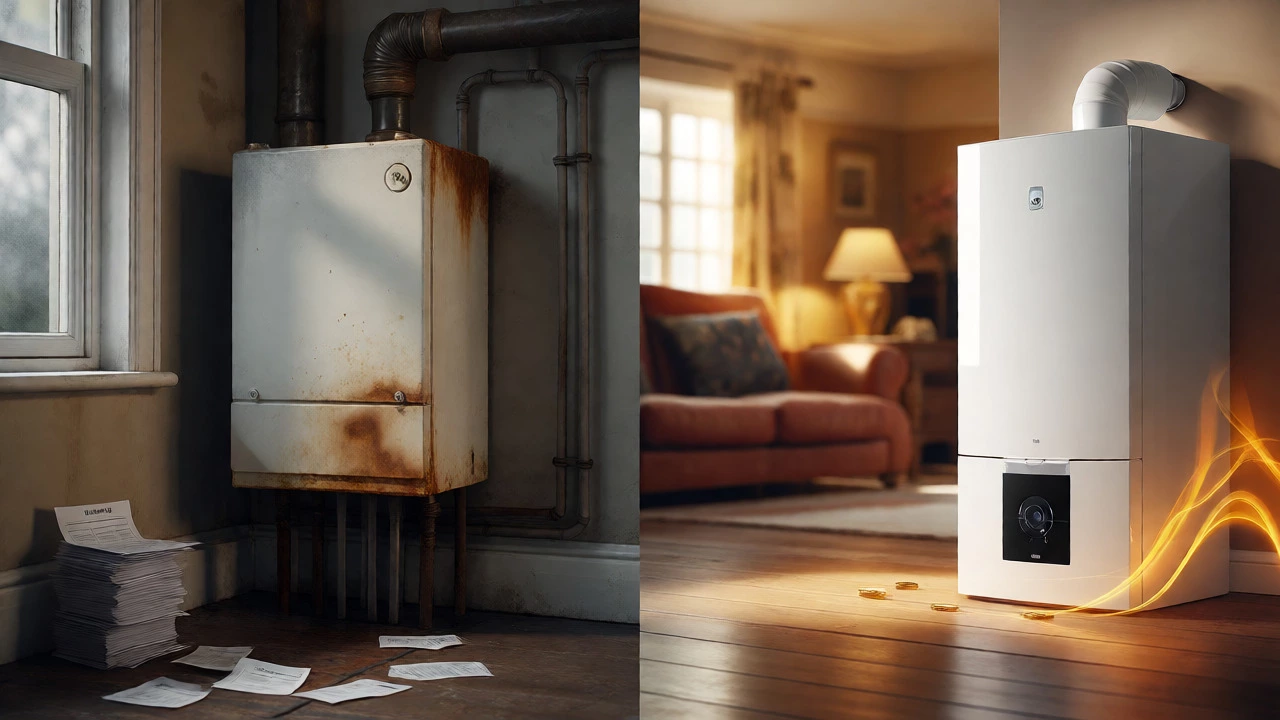
This is the silent killer in the repair vs. replace debate. An old boiler might operate at 70-75% efficiency. Modern condensing boilers run at 90-94%. That 15-20% difference translates directly into your energy bills. With gas prices fluctuating, every percentage point matters.
Let’s say your annual gas bill is £1,200. Upgrading to a high-efficiency model could save you roughly £180-£240 per year. Over ten years, that’s £1,800-£2,400 saved. If a repair costs £400 now but leaves you with an inefficient machine, you’re paying that “inefficiency tax” every month. Sometimes, the most expensive option upfront becomes the cheapest over time.
However, efficiency depends heavily on maintenance. A well-maintained 10-year-old boiler can still perform decently. If yours has been serviced annually and shows no signs of sludge buildup, repairing it might keep it running efficiently for another few years. But if it’s never been cleaned, a repair won’t fix the underlying inefficiency caused by scale and debris in the heat exchanger.
The Hidden Risks of Ignoring Warning Signs
Safety should always trump savings. If your boiler is losing pressure frequently, producing carbon monoxide warnings, or showing yellow flames instead of blue, you need professional advice immediately. These aren’t just inconvenience issues; they’re hazards.
- Frequent Lockouts: If your boiler resets itself multiple times a day, internal sensors or boards may be failing. This is unreliable and risky.
- Cold Spots in Radiators: Indicates sludge buildup. While power flushing can help, severe cases suggest the system is compromised.
- Noisy Operation: Kettling (banging noises) signals limescale or air locks. Left unchecked, this damages the heat exchanger.
If you experience any of these alongside an expensive repair quote, lean towards replacement. Continuing to patch up a struggling system increases the risk of a catastrophic failure during winter, when emergency call-out fees skyrocket.
When Repairing Makes Perfect Sense
Don’t assume replacement is always better. There are clear scenarios where fixing your existing unit is the smart move:
- Your Boiler is Under Warranty: If it’s less than 7 years old and still covered, repairs should be free or low-cost. Never pay for a repair if the manufacturer covers it.
- Budget Constraints: If you can’t afford £2,500+ right now, a moderate repair buys you time. Plan for replacement within 12-18 months.
- Rental Properties: Landlords often prefer repairs to maintain cash flow, provided the boiler passes its annual gas safety check.
- Specific Part Failure: Issues like a faulty thermostat or external sensor are cheap fixes that restore full function without touching the core mechanics.
In these cases, ask your engineer for a diagnostic report. If they recommend replacing the whole unit for a minor issue, get a second opinion. Trust is key in this industry.
How to Get the Best Deal on Repairs or Replacements
Whether you choose to repair or replace, how you approach the purchase matters. Always use a Gas Safe registered engineer. Check their registration number on the official Gas Safe Register website. Don’t rely solely on word-of-mouth; verify credentials.
For replacements, get at least three quotes. Ensure each quote specifies the brand and model of the boiler. Avoid vague estimates like “new combi boiler.” Look for reputable brands like Worcester Bosch, Vaillant, or Ideal, which have strong support networks in the UK. Also, ask about additional components: will they install a magnetic filter? Will they upgrade your controls to smart thermostats? These add-ons improve longevity and control.
For repairs, ask for a detailed breakdown of parts and labour. If the part is obsolete, ask if it’s still available. Some older models require custom-order parts, leading to delays. If waiting means days without heating, factor that discomfort into your decision.
Final Verdict: What Should You Do?
Here’s a quick checklist to guide your final decision:
- Age > 15 years? Replace.
- Repair cost > 30% of new boiler? Replace.
- Warranty expired + frequent faults? Replace.
- Energy bills rising despite usage stability? Replace.
- Under 10 years + single component failure? Repair.
- Tight budget + safe operation? Repair and save for future replacement.
Ultimately, a boiler is an investment in your home’s livability. Spending money on a reliable system reduces stress and unexpected costs. If you’re unsure, invite a trusted local engineer for a no-obligation assessment. They can inspect the physical condition, check combustion quality, and give you a realistic lifespan estimate. Use that data to make a choice that balances immediate needs with long-term savings.
How long do modern boilers last?
Modern condensing boilers typically last between 10 and 15 years. However, regular annual servicing and proper water treatment (like adding inhibitors) can extend this lifespan to 20 years or more. Neglected systems often fail around the 10-year mark due to sludge and corrosion.
Is it cheaper to repair or replace a 15-year-old boiler?
Generally, it is cheaper to replace a 15-year-old boiler. At this age, multiple components are likely near the end of their life. Repairing one part often leads to another failing shortly after. Additionally, newer models offer significantly higher efficiency, saving on energy bills enough to offset the initial replacement cost over several years.
What is the average cost of a new boiler installation in the UK?
As of 2026, a standard combi boiler installation ranges from £2,500 to £3,500. This includes the unit, labour, flue, and basic accessories. High-end models or complex installations involving system changes can exceed £4,000. Always get itemized quotes to compare apples to apples.
Can I negotiate the price of a boiler repair?
Yes, but carefully. Fixed-price contracts often include diagnostics and common parts. For non-contract customers, engineers may charge hourly rates plus parts. Ask for a written estimate before work begins. If the repair involves specialized parts, confirm availability first to avoid extra trip charges.
Does a new boiler increase home value?
A new, efficient boiler can slightly increase home value and appeal to buyers who prioritize low running costs. More importantly, it removes a potential red flag during property surveys. Buyers dislike inheriting old appliances with unknown lifespans, so a recent installation adds peace of mind.